Well, we got our rain. I'd even consider it a good dousing; there was so much that we had puddles in the garden 2 days after the rain and haven't had to water since last week. However, conditions weren't exactly ideal for doing much work in the garden, not even walking. So, we had to leave it be for a few days.
But, yesterday we were back in action. The 2nd succession of spinach, beets, and carrots were planted. In this way, we'll make sure to harvest those veggies for a longer period instead of being inundated with one crop at a time. If Bubba wanted to be a farmer instead of a shrimp boat captain, his line might have read something like this: "Dey's uh.... raw carrots, cooked carrots, carrot cake, carrot muffins, carrots in salads, carrots in soup, boiled carrots, baked carrots..."
There is nothing like a fresh carrot from your garden, but I think our skin would have turned orange from all the carotene. Thus, plant in successions! I left 10 days between the spinach plantings, nearly 2 weeks between beet sowings, and almost 3 weeks for the carrots. I'm hoping to fit even more carrots under some tomato plants further along in the season. The shade of the tomatoes will keep it nice and cool for those carrots to live long and prosper.
Off to the plot for turnip and parsnip planting!
Friday, April 30, 2010


Friday, April 23, 2010
Rain, rain, come our way!
So, we're nearing the end of April and we're missing 3 inches in rainfall! What's a farmer to do? Well, to be honest, we haven't done much. So far, watering at night or early in the morning has been just fine... at least in the sense that there are still signs of life. Other than keeping things moist with our tiny watering can, we wait patiently for the real thing. This weekend, we are supposed to get at least an inch of rain. That would be terrific and would also give our weary bodies a little rest. Hopefully, you get a nice little rest this weekend, too.
I'll let the photos do the rest of the talking.

Row of potato hills.
 Zoomed in

Mini greenhouses made from halved plastic bottles...these are working like a charm on my broccoli transplants!

Baby lettuce that I had a kick hand weeding...no joke.

Our picturesque view from the plot.

A bunny buddy.

I'll let the photos do the rest of the talking.

Row of potato hills.


Mini greenhouses made from halved plastic bottles...these are working like a charm on my broccoli transplants!

Baby lettuce that I had a kick hand weeding...no joke.

Our picturesque view from the plot.

A bunny buddy.

Proud
Wednesday, April 21, 2010
Photos for you to enjoy


And here we are.
Monday, April 19, 2010
Transplant Time!
Woke up early to get to the plot before it got too warm and sunny to transplant. However, I spent two hours preparing and marking out the beds before I could even start on transplants. Nevertheless, the collards and broccoli are transplanted, and the spinach, baby choi, and green onions are all seeded. Just under half of the plants are in, and it's not even May. Hooray for early veggies!
I used some of this fish emulsion fertilizer mixed with water to assist my tiny transplants in surviving the shock of their new situation. I also made sure to water my plants while in the middle of covering them with soil. In this way, less H2O is lost to evaporation and more is left to take care of the plants.
Will update more with pics soon!
I used some of this fish emulsion fertilizer mixed with water to assist my tiny transplants in surviving the shock of their new situation. I also made sure to water my plants while in the middle of covering them with soil. In this way, less H2O is lost to evaporation and more is left to take care of the plants.
Will update more with pics soon!
Friday, April 16, 2010
This past week in the garden!
Our weather here in Cincy has been outrageous....it reached 84 degrees yesterday! We've been enjoying it every way possible, biking, reading on the porch, dog-walking, bonfires, eating every meal outdoors, and of course, gardening!
I've been over to the plot every day this week. Waiting, and hoping, and wishing, and praying that something...just one little something would sprout. And guess what?!? Today, I was blessed with that something. Actually 13 somethings! I counted 11 new sugar snap pea babies, 1 potato bud poking through, and 1 carrot sprouting forth. It made my day. Here are pics of the sugar snap peas:


Here is the potato!
Other than watching the garden in it's first stages of growth, we have been busy tending to the weeds, marking out new beds, adding compost, keeping things moist, and most importantly in April, planting. Chris and I managed to beat the rain and get in the beet seeds and my pathetic looking onion transplants today. You see, in my efforts to harden off the onions, I managed to kill about half of them. Thus, only 6 little onions were tucked in to the soil. However, I have quite a few (about 40) growing on the side of the house. I had planted those in the fall in a cold frame and there they grew (slowly) all winter long. I think we're set with onions no matter what happens with the 6 in the plot.
Next to the onions, I direct seeded some Tall Top Early Wonder Beets. Chris says the seeds look like chocolate clusters dipped in carmel...which beets don't taste anything like, but to me, are just as delicious! Beets and onions are good companion plants so I'm hoping the beets can help the onions along.
By next week, we hope to have all of the giant monster weeds out of the garden and get the brassicas (cabbage, broccoli, califlowers, turnips, radishes, etc.) planted. Although I'm dissappointed with my onions, and it might help the potatoes if we had some cooler and wetter weather...we are right where we need to be!

I've been over to the plot every day this week. Waiting, and hoping, and wishing, and praying that something...just one little something would sprout. And guess what?!? Today, I was blessed with that something. Actually 13 somethings! I counted 11 new sugar snap pea babies, 1 potato bud poking through, and 1 carrot sprouting forth. It made my day. Here are pics of the sugar snap peas:


Here is the potato!
Other than watching the garden in it's first stages of growth, we have been busy tending to the weeds, marking out new beds, adding compost, keeping things moist, and most importantly in April, planting. Chris and I managed to beat the rain and get in the beet seeds and my pathetic looking onion transplants today. You see, in my efforts to harden off the onions, I managed to kill about half of them. Thus, only 6 little onions were tucked in to the soil. However, I have quite a few (about 40) growing on the side of the house. I had planted those in the fall in a cold frame and there they grew (slowly) all winter long. I think we're set with onions no matter what happens with the 6 in the plot.
Next to the onions, I direct seeded some Tall Top Early Wonder Beets. Chris says the seeds look like chocolate clusters dipped in carmel...which beets don't taste anything like, but to me, are just as delicious! Beets and onions are good companion plants so I'm hoping the beets can help the onions along.
By next week, we hope to have all of the giant monster weeds out of the garden and get the brassicas (cabbage, broccoli, califlowers, turnips, radishes, etc.) planted. Although I'm dissappointed with my onions, and it might help the potatoes if we had some cooler and wetter weather...we are right where we need to be!

Thursday, April 8, 2010
Tilling and Planting Potatoes
So I've been busy.... the plot is tilled and the potatoes are in the ground along with the sugar snap peas!
Right before Easter weekend, we were blessed to receive free rental of a rottotiller by the land owner (which, for you curious folk, would be $34 for a couple hours). We made do with the semi-moist soil and quickly went over the plot twice. There were some corners we had to skip over due to them being a bit too sticky and my concern for damaging the soil. It is especially important when working with clay soil to be careful not to work with it when it's too wet. Hopefully, we made the right decision ....I don't know when it would have been drier. Here are some photos of our first rottotiller extravaganza:
The plot, pre-tilled

.
The tiller and one of our mascots


After enjoying the holiday weekend, we got back to work to plant the nicely sprouted potatoes. Chris measured out the bed, and using electrical fence flags to mark out the shape, we got to breaking up and readying the soil for planting. This included digging a 6-8" trench down the middle of a 30" bed. I have my beds spaced a bit closer than what is normal but not detrimentally close. We stuck in the taters sprout-side up and covered them with about 4 inches of soil, firming it lightly. We'll keep an eye (haha) on the potatoes as they grow, making sure to add more and more layers until a small hill is formed. This technique will prevent the tops of the new taters from turning green from the sun. Safety tip: If you end up with green potatoes, those parts should be cut off. That is because a harmful toxin, solanine, is present there and can only only be 'cooked away' through some methods and not others. Thus, to be safe, chop off the green and enjoy your potatoes in peace.
Here is a photo of the 'E' shaped bed we created. It is about 10' x 12', doesn't look like much but holds 42 seed potatoes spaced about a foot apart:

Here I am shaping the trench

Now the potatoes are tucked away.

Next...more weeding then onion, beet, lettuce, and spinach planting.
Frost-free date coming soon: April 15th!
Right before Easter weekend, we were blessed to receive free rental of a rottotiller by the land owner (which, for you curious folk, would be $34 for a couple hours). We made do with the semi-moist soil and quickly went over the plot twice. There were some corners we had to skip over due to them being a bit too sticky and my concern for damaging the soil. It is especially important when working with clay soil to be careful not to work with it when it's too wet. Hopefully, we made the right decision ....I don't know when it would have been drier. Here are some photos of our first rottotiller extravaganza:
The plot, pre-tilled

.
The tiller and one of our mascots


All done! For now.
Here is a photo of the 'E' shaped bed we created. It is about 10' x 12', doesn't look like much but holds 42 seed potatoes spaced about a foot apart:

Here I am shaping the trench

Now the potatoes are tucked away.

Next...more weeding then onion, beet, lettuce, and spinach planting.
Frost-free date coming soon: April 15th!
Wednesday, March 31, 2010
Progress
Here are the promised photos of seedling progress:


I should be tilling by the end of this week. It's supposed to stay warm, dry, and beautiful for the next few days. Check back soon for more!

My setup in the dinning room. It works.

Baby Eggplant

The potatoes are sprouting nicely. These are the Austrian Crescent.
Thursday, March 25, 2010
Floating Row Cover Is My Friend!
Yesterday, Chris and I ventured out to a garden center I have known of for awhile but never had a reason to drive out and visit, until now! After numerous phone calls to local plant nurseries, garden, home and landscaping stores, and even a Tractor Supply Co., I succummed to the realization that no store carried floating row cover-an item of utmost importance to my farming project. However, after one last go at scouring the net, I came across Marvin's Organic Gardens in Lebanon, Ohio. I determined (after a month's worth of weekly phone calls to check the shipping progress of this most-coveted item) that they did indeed sell row cover or frost cloth. I'm not sure why Cincinnati garden centers don't carry this item and very surprised that big box stores don't bother with it either. In my thinking, this prime gardening product would be everywhere, but most places I contacted didn't even know to what I was referring. So, I figured I could at least fill you in!
This product is something I did without for my first gardening venture last year in MO, but have every intention of utilizing this time around. Floating row cover is a great aid for the organic gardener. Since I didn't personally take advantage of this plant protection but watched as my fellow apprentice farming friends did and subsequently harvested delicious produce, I can easily attest to the postive outcome of its use and the negative results I experienced. This 'garden blanket' of sorts looks almost like a giant dryer sheet (sans fresh scent), can let light, air, and water in but prevents pests, extreme heat, and frost from bothering your veggies! It is laid atop the plants and needs no support from below but should be weighed down on the edges. It can be used over and over again if treated properly and allows gardeners to create a mini greenhouse effect for young plants or seedlings transplanted outdoors earlier than usual. One word of advice....remember to take off the cover once your plants flower so they can be pollinated! By then, they should be hardy enough to withstand most pest attacks.
I plan on using my row cover to protect my young eggplants from pests. I gleaned ZERO eggplant during last season; flea beetles made lace work of the eggplants' leaves and thus, made it nearly impossible for the poor things to bear fruit. This year will be different, and I'm already daydreaming of making my favorite eggplant parmesean dish or my potato and eggplant curry !
So, if you're planning on setting out some fragile transplants or want to start your veggies earlier or protect them from the heat in the middle of summer, I highly recommend buying yourself a resuable sheet of row cover. Try your local nurseries (hopefully, your luckier than me) or resort to paying for S&H and buy yours online. I bought the exact product that I've linked below. I spent $15.00 and did have to drive a bit farther than I would like, but I got to support a local, family business and enjoy a drive out to some true farm country!
This product is something I did without for my first gardening venture last year in MO, but have every intention of utilizing this time around. Floating row cover is a great aid for the organic gardener. Since I didn't personally take advantage of this plant protection but watched as my fellow apprentice farming friends did and subsequently harvested delicious produce, I can easily attest to the postive outcome of its use and the negative results I experienced. This 'garden blanket' of sorts looks almost like a giant dryer sheet (sans fresh scent), can let light, air, and water in but prevents pests, extreme heat, and frost from bothering your veggies! It is laid atop the plants and needs no support from below but should be weighed down on the edges. It can be used over and over again if treated properly and allows gardeners to create a mini greenhouse effect for young plants or seedlings transplanted outdoors earlier than usual. One word of advice....remember to take off the cover once your plants flower so they can be pollinated! By then, they should be hardy enough to withstand most pest attacks.
I plan on using my row cover to protect my young eggplants from pests. I gleaned ZERO eggplant during last season; flea beetles made lace work of the eggplants' leaves and thus, made it nearly impossible for the poor things to bear fruit. This year will be different, and I'm already daydreaming of making my favorite eggplant parmesean dish or my potato and eggplant curry !
So, if you're planning on setting out some fragile transplants or want to start your veggies earlier or protect them from the heat in the middle of summer, I highly recommend buying yourself a resuable sheet of row cover. Try your local nurseries (hopefully, your luckier than me) or resort to paying for S&H and buy yours online. I bought the exact product that I've linked below. I spent $15.00 and did have to drive a bit farther than I would like, but I got to support a local, family business and enjoy a drive out to some true farm country!
Wednesday, March 24, 2010
Eggplants, Tomatillos, and Broccoli....Oh, My!
So I am moving on to starting my second round of seedlings...the eggplants and tomatillos. When I mention broccoli I'm referring to my ongoing attempt to salvage what few seeds and sprouts I started after the first broccoli failure. I think I may have solved my problem seeing that I now have a 2 inch broccoli sprouts reaching high into the sky! Those were the ones that I had seeded directly into the pots while the ones I let germinate in moist paper towels and plastic bags were planted today. What I decided to do this time around was add a bit of potting soil with my seed starting mix (about half and half) and also more vigorously tamper down the soil after planting. So far, things are looking good. I am hopeful that the little tweaks I made will prevent air from drying out my babies as they seemed to do to the last broccoli I had started.
Those are my homemade newspaper pots and the new starting mix I made. I followed a video on E-How to make my pots; they are very simple and there is a lot of other information and how-to's online.

 Using my marker as a hole puncher (soil tends to stick to my finger tend more than the slippery butt end of the marker). Give it a try!
Ready for the seedlings!

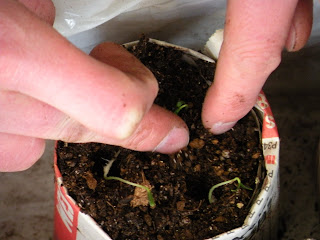
Tampering down the soil and hopefully, eliminating any trapped air pockets.
There you have it! I will take pics of all my seedlings soon!
Off to the garden center for goodies!
Here are some photos of the process:
Those are my homemade newspaper pots and the new starting mix I made. I followed a video on E-How to make my pots; they are very simple and there is a lot of other information and how-to's online.

This is the paper towel/plastic bag germination method.

Here are the tomatillo sprouts!


Ready for the seedlings!


Tampering down the soil and hopefully, eliminating any trapped air pockets.
There you have it! I will take pics of all my seedlings soon!
Off to the garden center for goodies!
Friday, March 19, 2010
Getting to the bottom of this...
Today is beautifiul here in Cincinnati! Despite my horrible allergy congestion and a hazy mind, Chris and I set out to the plot with rakes, wheelbarrel, and my new stirrup hoe for our first on site preparation! Our goal: clear out the masses of straw and garden waste that had accumlated and place them....somewhere. I'll tell you what we came up for a solution after a few images so you can better understand the land we are working. Here are the 'before' photos:


Since this plot is not located on land that I own, I don't exactly have an area to place my excess straw outside of the garden. Thus, I made a quick decision that should solve several issues that I was going to have to deal with at some point during the growing season. We started a compost pile!
Ok, so right now it's more of a waste straw pile and doesn't contain the proper ratio of carbon to nitrogen or anything to help it actually morph into beautiful, rich compost, but it will; just wait and see! So, I solved the immediate issue of what to do with 5 wheelbarrows full of straw mush and the other dilemma of having a poorly drained corner in the garden. Instead of trying to grow food in that utra mushing section or just letting it sit fallow, I will utilize it as my compost heap and thus, maximaze all of the space I have. The final positive outcome of this decision is that I now have a moist and fertile space that will be the perfect home to grow my squash (Buttercup, Yellow, and Zuchinni). Even though this wasn't my original plan, I find it comforting and also exciting to get a chance to see how this old-fashioned method can work to keep my squash watered and supplied in nutrients!
Here is an 'after' photo:

The plot: 30' x 50'

STRAW MANIA!!!


Since this plot is not located on land that I own, I don't exactly have an area to place my excess straw outside of the garden. Thus, I made a quick decision that should solve several issues that I was going to have to deal with at some point during the growing season. We started a compost pile!
Ok, so right now it's more of a waste straw pile and doesn't contain the proper ratio of carbon to nitrogen or anything to help it actually morph into beautiful, rich compost, but it will; just wait and see! So, I solved the immediate issue of what to do with 5 wheelbarrows full of straw mush and the other dilemma of having a poorly drained corner in the garden. Instead of trying to grow food in that utra mushing section or just letting it sit fallow, I will utilize it as my compost heap and thus, maximaze all of the space I have. The final positive outcome of this decision is that I now have a moist and fertile space that will be the perfect home to grow my squash (Buttercup, Yellow, and Zuchinni). Even though this wasn't my original plan, I find it comforting and also exciting to get a chance to see how this old-fashioned method can work to keep my squash watered and supplied in nutrients!
Here is an 'after' photo:

Thursday, March 18, 2010
The taters have arrived!

Well, the potatoes are here and I am ecstatic! Those were the last of the seeds to arrive. I purchased the majority of my seeds from Seed Savers Exchange...at least the important ones that I knew of which I would want the special heirloom varieties. I got a total of 5 lbs. of seed potatoes, half Austrian Crescent (a variety of fingerling I grew and ate while working on the farm in Missouri) and the other portion Red Gold. They are beautiful all perked upright in my homemade chitting (a new word I learned for 'sprouting') crates. Take a look for yourself!

I wanted to use egg cartons, but alas, today the recycling got picked up. So, I found some boxes Chris had been hoarding and proceeded to cut small holes with a utility knife and stick the 'rose end' or 'seed end' up. In case you're new to this like me, the 'seed end' has all of the eyes or little dents, and that's where you are trying to encourage the sprouting. I will place these boxes of spuds in a room with adequate natural light and wait until the sprouts get over 1/2 inch before taking them out to plant. I may be a bit behind but no worries...it's not like I have the plot tilled, yet!
Now, I just have to get that land worked. I'm currently waiting on consecutive warm and dry days to warm up and drain the land. The area I will be working in (it has farmed before and comes complete with a very tall fence and water on site-so I shouldn't complain) is on a slight slope and also seems to be in a soggier area of the land. I am also still determining my layout but hope to have that finished very soon.
Until then, I will be enjoying the sunshine, and I think, tomorrow I will take a trip to the plot to study the weeds and contemplate a course of action.
Wednesday, March 17, 2010
Photos for you!

It's a quaint scene...but this is the beginning of the failed broccoli.

Here is a close up of the germinated broccoli...
this is its most glorious moment.
Thursday, March 11, 2010
Broccoli Failure
Each day, when I decide to sit down to complete my official garden plot layout (scaled on graph paper and everything!) I find myself feeling inept or maybe it's lethargy that I feel. Either way, I feel somewhat stuck or hesitant. I have drawn up a few sketches and I have a list of the plants I'm growing, but I'm not completely sure of how I want to approach this project. I know I will be doing several succession plantings (is that redundant?), and I will be trying my hand at some companion planting (ya know, marigolds with tomatoes...) but I'm still not set on my layout. Any suggestions?
But, what I can expand on (to an inappropriate extent) are my broccoli seedlings and the broccoli tragedy I've experienced as of late. You see, my seed germination had been going rather well and honestly, now that I'm writing this down, I can see how this could seem rather trivial, even silly. But, even in just a few weeks of buying, germinating, and starting seeds the seedlings have become family; they are my babies. Why else do you think they call it a nursery? I feel like a mother and feel that it's my duty to see my progeny succeed...or at least live!
The collards, marigolds, onions, and dianthus are all looking fresh, green, and perky. My broccoli, the same, until a week ago. It started with the poor little 1 inch green seedlings just looking a bit droopy, like a bed of sad puppies. I watered them a little extra and moved the flat away from such harsh sun. Then, they were wilty like old lettuce, so I just watched and waited. And finally(I guess I waited too long), they were all black and crunchy like raisinsfound under a car seat. I tried to salvage the little buddies for another week but to no avail. They are gone for good, and it's a true broccoli failure.
So, today I planted some more....and life goes on! I'm doing a bit of a mini-experiment; I planted half of the remaining broccoli seeds strait into the starting mix in little pods while the rest went into a moist "envelop" made of paper towels resting in a shallow dish and slid into a plastic baggie. I am curious to see which will grow faster or which will last longer than two days(which is the current record for broccoli in my makeshift plant nursery).
So as not to get too down about the broccoli and to remind myself that it's not too late, I've been concentrating on all of the other plants I'll be getting to grow this year. I thought I would share them with you. Hope you enjoy this list as much as me!
Since I am using this blog as my gardening journal there will also be information that may seem superfluous to some of you but vital to me. Next to some of the plants you will notice the date I started germination or planted the seedling indoors...it seems I am running a little behind but better late than never!
Listada de Gandia Eggplant (March 12th germination)
Peppers (purchasing transplants)
Tomatoes (purchasing transplants)
Tomatillos (March 12th germination)
Early Fortune Cucumbers
True Lemon Cucumbers
Black Beauty Zuchinni Squash
Golden Zuchinni Squash
Icicle Short Top Radishes
Dragon Carrots (Sown in cold frame 3/6)
Spinach-Double Choice Hybrid (Sown in cold frame 3/6)
Romaine Lettuce-Parris Island Cos
Grand Rapids Loose Leaf Lettuce
Georgia Southern Collards (March 1st germination)
Baby Choi Cabbage
Genovese Basil
Cilantro
Rosemary
Sage
Harris Model Parsnips
Purple Top White Globe Turnips
Burpee's Golden Beets
Early Wonder Beet
Austrian Crescent and Red Potatoes
Yellow of Parma Onions (Feb. 25th germination and sown in cold frame)
Evergreen Long White Bunching Onions
Sugar Bon Snap Peas
Provider Green Beans
Fiskeby Soy Beans
Buttercup (Burgess Strain) Squash
Butternut Squash
Amish Melon
Moon and Stars Watermelon
Birdhouse Gourds
Sweet Corn-Perfect Picnic Hybrid
Marigold (March 1st germination)
Dianthus (March 1st germination)
Scabiosa
Sunflowers
Butterfly Flower
Babys Breath-Covent Garden White
Cosmos
Aster
Zinnia
Cornflower
Petunia
Larkspur
Calabrese Broccoli (Feb. 25th(failed) and March 11th germination)
Saturday, March 6, 2010
Something to chew on...
Today, I learned that out of the funds my parents have spent on 20 years worth of home upkeep and remodeling, a tenth of those monies have been used toward landscaping and maintaining the yard. This amount includes but is not limited to all mulch, fertilizer, plants, pots, soil, seed, and decorative components used in the yard. It does NOT include any garden-specific tools, machinery, or the watering of said landscaping. While it could get much more extravagant than this percentage, it is still a decent amount of money and shouldn't every homeowner examine his or her spending?
My point in bringing up my parents' personal finances? Well, it's all relevant....they're using money, time, and space to create a beautiful and, I'll agree enjoyable facade. It's even something I know they enjoy spending money and time doing, but, nevertheless, it is still a facade. OK, maybe they plant some herbs or even a tomato plant for the fun of it, but they don't concentrate on farming for food or what I would call 'landscaping for life'. They get their food from the grocery and haven't, until recently, thought much beyond what day of the week they'll get to the store. They are ornamental horticulturalists by education and thus, concentrate on making their lawn and landscaping look beautiful for themselves, for their property value, for guests, for the neighbors...for the sake of social norms. Those may all be valid, lovely reasons, and I can personally say that I understand each one. However, I can't completely rectify spending so much of everything with not much to show for it besides 20 years of having a nice yard and having the approval of neighbors. If you take a moment to meditate on 20 years worth of watering, fertilizing, purchasing, decision making, and maintaining a facade of responsibility, organization, and beauty....it's quite disgusting. Besides, if one is trying to make one's property appear pure, beautiful, and I'll assume, natural, (since we are dealing with items found in nature) it is pretty ironic, disappointing, and pitifully disrespectful to consider how truly forced, phony, and disruptive landscaping for looks truly is. I suppose if there were no other way to develop one's lawn then I wouldn't have a problem with ornamental landscaping. In fact, I would see it as a respectful nod of recognition and admiration to the natural beauty of plants and earth. But, the problem is, there is something else that can be done to our lawns that is less boring, less intrusive, and less wasteful. Why plant lawns when we can plant food?
Maybe you think I'm being too harsh, especially since I used my own parents as a springboard for this tirade. And I understand... I've thoroughly enjoyed running around on our plush lawn, helping my mom plant spring flowers, or trimming hedges with my dad. I even think these experiences shaped who I am and specifically shaped me into someone who loves the outdoors and working in the dirt to produce beautiful things. The difference is what we're producing....just something to chew on.
My point in bringing up my parents' personal finances? Well, it's all relevant....they're using money, time, and space to create a beautiful and, I'll agree enjoyable facade. It's even something I know they enjoy spending money and time doing, but, nevertheless, it is still a facade. OK, maybe they plant some herbs or even a tomato plant for the fun of it, but they don't concentrate on farming for food or what I would call 'landscaping for life'. They get their food from the grocery and haven't, until recently, thought much beyond what day of the week they'll get to the store. They are ornamental horticulturalists by education and thus, concentrate on making their lawn and landscaping look beautiful for themselves, for their property value, for guests, for the neighbors...for the sake of social norms. Those may all be valid, lovely reasons, and I can personally say that I understand each one. However, I can't completely rectify spending so much of everything with not much to show for it besides 20 years of having a nice yard and having the approval of neighbors. If you take a moment to meditate on 20 years worth of watering, fertilizing, purchasing, decision making, and maintaining a facade of responsibility, organization, and beauty....it's quite disgusting. Besides, if one is trying to make one's property appear pure, beautiful, and I'll assume, natural, (since we are dealing with items found in nature) it is pretty ironic, disappointing, and pitifully disrespectful to consider how truly forced, phony, and disruptive landscaping for looks truly is. I suppose if there were no other way to develop one's lawn then I wouldn't have a problem with ornamental landscaping. In fact, I would see it as a respectful nod of recognition and admiration to the natural beauty of plants and earth. But, the problem is, there is something else that can be done to our lawns that is less boring, less intrusive, and less wasteful. Why plant lawns when we can plant food?
Maybe you think I'm being too harsh, especially since I used my own parents as a springboard for this tirade. And I understand... I've thoroughly enjoyed running around on our plush lawn, helping my mom plant spring flowers, or trimming hedges with my dad. I even think these experiences shaped who I am and specifically shaped me into someone who loves the outdoors and working in the dirt to produce beautiful things. The difference is what we're producing....just something to chew on.
Friday, March 5, 2010
The Adventure Begins...
An opportunity has presented itself. For this growing season, I will be taking on a new gardening project. Although I won't be working at markets or attending weekly enrichment sessions like my last organic garden undertaking with EarthdanceFarms, this time is going to be just as challenging and just as enriching. This time, I will be in charge of EVERYTHING.
Through the generosity of a neighbor and my determination to be my own boss, I have taken responsibility for 1500 square feet (30x50) of prime farm land. I will be embarking on a personal journey filled with a lot of hard work, numerous trials and probably even more errors and hopefully, a lot of growth by both vegetable and human.
So, although I have a decent understanding of how to grow things and enough confidence to risk my time and money on my own plot, I only know a fraction of what I could about gardening. I'm a pretty normal gal that has gotten herself into something she knows she wants but will take some time to figure out. For example, I don't really understand the ends and outs of "amending the soil" or know when I should start my seeds without having to refer to the packets in which they came. I certainly don't have all the right tools, and I already know I bought way too many seeds, but that's part of the fun of it all. I'm giving myself permission to get caught up in the giddiness of making plans and the excitement of anticipating all the delicious treats to come(God willing). Knowing all the potential knowledge to be acquired makes me all warm and fuzzy which leaves no room for hesitancy or fear. Things are certain to happen that won't be ideal, but the hypothetical issues I foresee will, in themselves, be a blessing and next year, I'll try to prevent or fix those issues. If I succeed, I succeed. If I fail, I succeed...eventually.
However, I do take comfort in knowing that every gardener, no matter age, background, or experience has difficulties or issues that arise each year that have nothing to do with personal ability or personal effort. Weather, seed failure, poor soil quality(OK so, I suppose these can be controlled or corrected to some extent...but you get my point) all affect the success of a garden and the morale of the gardener and are things that can't be completely determined or righted with human efforts. I guess I like knowing that it's not ALWAYS going to be my fault if something goes wrong.
Thus, my plans for the plot...
Through the generosity of a neighbor and my determination to be my own boss, I have taken responsibility for 1500 square feet (30x50) of prime farm land. I will be embarking on a personal journey filled with a lot of hard work, numerous trials and probably even more errors and hopefully, a lot of growth by both vegetable and human.
So, although I have a decent understanding of how to grow things and enough confidence to risk my time and money on my own plot, I only know a fraction of what I could about gardening. I'm a pretty normal gal that has gotten herself into something she knows she wants but will take some time to figure out. For example, I don't really understand the ends and outs of "amending the soil" or know when I should start my seeds without having to refer to the packets in which they came. I certainly don't have all the right tools, and I already know I bought way too many seeds, but that's part of the fun of it all. I'm giving myself permission to get caught up in the giddiness of making plans and the excitement of anticipating all the delicious treats to come(God willing). Knowing all the potential knowledge to be acquired makes me all warm and fuzzy which leaves no room for hesitancy or fear. Things are certain to happen that won't be ideal, but the hypothetical issues I foresee will, in themselves, be a blessing and next year, I'll try to prevent or fix those issues. If I succeed, I succeed. If I fail, I succeed...eventually.
However, I do take comfort in knowing that every gardener, no matter age, background, or experience has difficulties or issues that arise each year that have nothing to do with personal ability or personal effort. Weather, seed failure, poor soil quality(OK so, I suppose these can be controlled or corrected to some extent...but you get my point) all affect the success of a garden and the morale of the gardener and are things that can't be completely determined or righted with human efforts. I guess I like knowing that it's not ALWAYS going to be my fault if something goes wrong.
Thus, my plans for the plot...
To be continued...
Monday, March 1, 2010
Saturday, February 20, 2010
Countries Struggling
Countries struggling with new ozone restrictions:
Bonner Cohen from the Heartland Institute
Bonner Cohen from the Heartland Institute
Thursday, February 4, 2010
Subscribe to:
Posts (Atom)


